The Easiest Way to Build Your Own AI Agent Team
If you have not read my earlier guides, start there first:
Those two pieces cover setup and cost discipline. This one covers team design.
Most people try to build one super-agent. I got better outcomes by building a small team of specialized agents with clear roles. Think of it like hiring a compact executive team.
My Current Setup
I am still experimenting, not running a business KPI machine yet. My objective is simple: reduce mental load and ship better work.
My team:
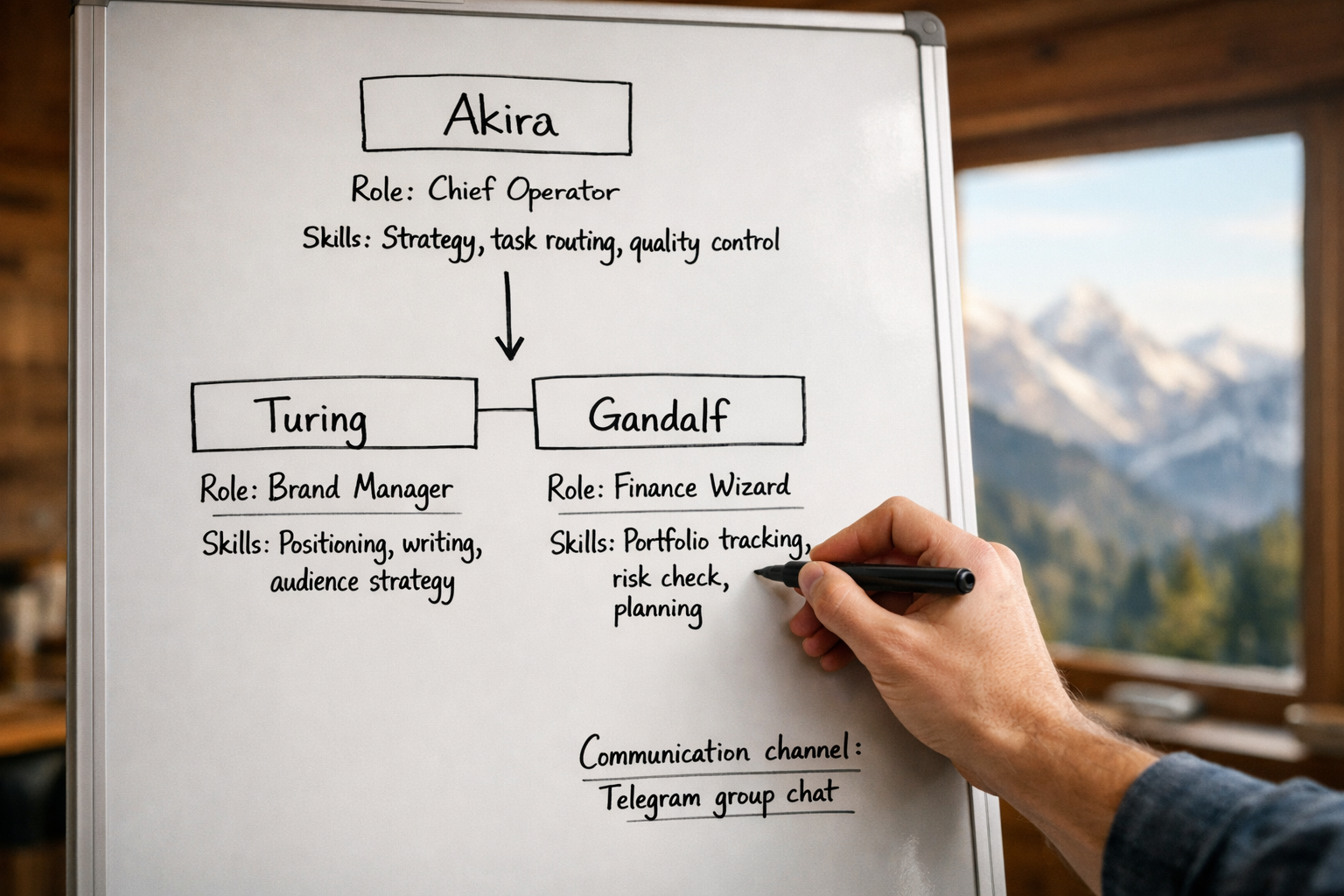
- Akira: operator-in-chief, allocates tasks, decides priorities, sets standards.
- Turing: brand strategist and writing partner for AI + business narratives.
- Gandalf: finance assistant for portfolio tracking and planning prompts.
This hierarchy gave me two wins:
- Better task separation.
- Cleaner memory and persona boundaries.
OpenClaw supports this structure directly with isolated workspaces, per-agent auth profiles, and separate session stores per agentId.
Step 1: Start with a whiteboard
Before touching tooling, draw this:
- Your goals.
- Your repeating task categories.
- Which role owns each category.
- Escalation path when an agent is uncertain.
If a role cannot be explained in one sentence, it is too fuzzy.
Step 2: Define each agent in plain language
For each role, write:
- Mission (one line)
- Scope (what it should handle)
- Escalation rule (when to hand off)
- Success metric (how you will evaluate it weekly)
Do this first. Model choice comes later.
Step 3: Use your files as the OS
In OpenClaw, agent behavior is shaped by workspace files like AGENTS.md, SOUL.md, and USER.md. These files are context infrastructure.
My practical pattern:
- Akira: starts close to default and evolves through interaction feedback.
- Turing: has a crafted voice and editorial standard.
- Gandalf: has risk-aware financial guardrails and strict non-advisory language.
Step 4: Persona design simplified
For Turing, I used recognizable style references:
- Kara Swisher for sharp tech instinct
- Ezra Klein for structured nuance
- Peggy Olson for positioning and audience framing
- Carl Sagan for clarity and intellectual honesty
Why this works:
- Public figures create fast stylistic anchors.
- The model likely has prior exposure to their public work.
- You reduce ambiguity in tone calibration.
Step 5: Start rough, then iterate weekly
Do not over-polish v1 files. Your first version should be compact and operational.
A good loop:
- Run tasks for a week.
- Review misses by category.
- Tighten instructions where failure repeats.
- Remove bloated lines that add token cost without quality gains.
Perfection on day one is expensive theater. Compounding improvements are where the value is.
A copy-paste starter template
Use this template for each specialist agent.
SOUL.md (identity and standards)
# SOUL.md

## Role
You are <AgentName>, responsible for <single core mission>.

## Personality
- Tone: <3-5 adjectives>
- Communication style: <short bullets>
- Decision style: <conservative/balanced/aggressive>

## Non-negotiables
- Never invent facts.
- Flag uncertainty.
- Escalate when confidence is low.

## Success definition
- A good response for this role looks like: <criteria>
AGENTS.md (operating instructions)
# AGENTS.md

## Scope
- In scope: <list>
- Out of scope: <list>

## Workflow
1. Clarify objective
2. Retrieve relevant context
3. Execute task
4. Return concise output + assumptions

## Escalation
If request includes <conditions>, route to <owner agent>.
USER.md (user profile)
# USER.md

- Name: <name>
- Preferences: <tone, structure, formatting>
- Red lines: <do not do>
- Ongoing priorities: <list>
Where this can fail (and how to avoid it)
- Role overlap: Two agents answer the same problem differently. Fix: tighter scope and explicit handoff rules.
- Prompt sprawl in memory files: Huge files raise token burn and blur priorities. Fix: keep only durable rules and recurring context.
Why I call this a “mixture of experts” setup
In classic machine learning, Mixture-of-Experts means routing work to specialized experts rather than using one dense model path for everything. At the user layer, we can apply the same logic: route tasks to specialized agents with clear domains.
It is not the same as model-internal MoE architecture. It is the operating principle adapted for practical workflows.
Final takeaway
Non-technical people do not need to become ML engineers to run agent teams well. You need three things:
- clean role design,
- clear files,
- weekly iteration discipline.
That is enough to build an AI team that is useful, safe, and cheap to operate.